
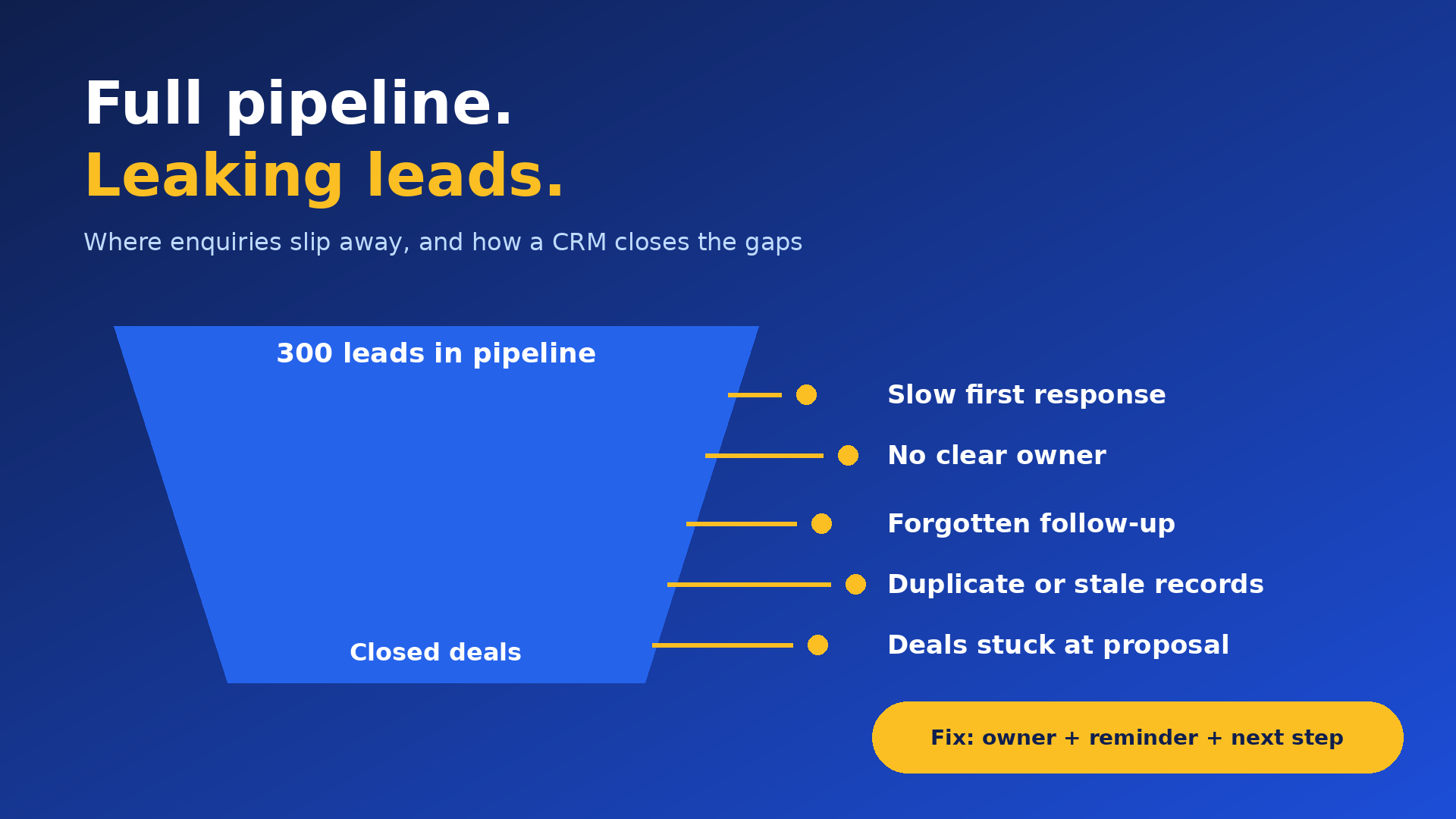
Short answer: Businesses lose leads when responses are slow, no one owns the follow-up, and deals have no next step. CRM customer relationship management fixes this with auto-assignment, reminders, and clear pipeline stages.
A full pipeline looks healthy on a dashboard, yet many teams still close fewer deals than their lead count suggests. The gap is usually process, not demand, and a complete guide to how a CRM works explains the foundation.
This article uses CRM customer relationship management as the lens to find where enquiries leak out of your funnel. You will see five common leak points, the speed benchmark that matters most, and a 30 day plan to close the gaps.
The Short Version
• Full pipelines leak when leads wait, lack an owner, or have no next step.
• Contacting a lead within an hour sharply raises the odds of qualifying it.
• Spreadsheets hide stalled deals, while a shared record makes every lead visible.
• Fix response time, ownership, and follow-up rules first, then add automation.
Why Do Businesses Lose Leads Even With A Full Sales Pipeline?
Businesses lose leads because volume hides neglect. A full pipeline can hold enquiries nobody has called, deals with no next step, and prospects who went cold while waiting. In CRM customer relationship management terms, the problem is rarely lead generation. It is what happens after a lead arrives.
Count is not the same as health. A pipeline of 300 leads sounds strong until you learn that 90 of them have had no activity for three weeks.
Here is an illustrative example. If your average deal is worth 50,000 rupees and one lead in ten closes, each untouched lead is worth about 5,000 rupees in expected revenue.
Ninety forgotten leads is then close to 4.5 lakh rupees left on the table, without spending a rupee more on advertising.
Teams that ask why leads fall through the cracks usually find the same three causes:
• Speed: the first reply arrives hours or days after the enquiry.
• Ownership: two people assume the other one will call.
• Memory: follow-ups depend on a sticky note, a chat message, or good intentions.
None of these is a talent problem. They are system problems, which means a system can solve them.
Where Do Leads Actually Leak Out Of The Pipeline?
Leads leak at five predictable points: the first response, the handoff to an owner, the follow-up schedule, the customer record, and the stalled deal stage. Each leak has a cheap fix once you can see it, and a shared record is what makes it visible.
|
Leak point |
What happens |
Fix |
|
First response |
The enquiry waits hours for a reply |
Instant alert plus a task with a deadline |
|
Ownership |
Nobody is clearly responsible |
Auto-assign every lead on arrival |
|
Follow-up |
The next call depends on memory |
Required next action and date on every deal |
|
Customer record |
Duplicates and old numbers waste calls |
One clean record per contact |
|
Stalled stage |
Deals sit in proposal for weeks |
Overdue alerts and weekly stage review |
Two of these leaks deserve a closer look. The first is ownership. When an enquiry lands in a shared inbox, every person assumes a colleague has picked it up, and the prospect hears nothing. Auto-assignment removes the guesswork in seconds.
The second is the customer record. Duplicate contacts and outdated phone numbers make reps call the wrong person or repeat a conversation. If your lead list lives in a file, Excel versus CRM software for growing businesses compares the two approaches honestly.
Notice that every fix in the table is a rule, not a gadget. Rules are what turn a list of names into a managed process.
How Fast Do You Need To Respond To A New Lead?
Faster than most teams manage. Researchers studying online leads concluded that most companies do not respond nearly fast enough, and a related analysis of 1.25 million leads found that contacting a lead within an hour made it nearly seven times as likely to qualify as waiting one more hour.
That finding comes from a peer-reviewed Harvard Business Review study of online sales leads, and its message is simple: interest fades quickly. A prospect who filled in your form at 11 am is comparing three suppliers by lunch.
Good CRM customer relationship management turns speed into routine. A new enquiry triggers instant assignment, a notification to the owner, and a task that shows up on their list.
You cannot rely on someone watching an inbox. The rule has to run whether the team is busy, in a meeting, or offline.
Evenings and weekends matter too. Many enquiries arrive when nobody is at a desk, and a Monday morning reply to a Saturday night lead is already late. Decide in advance who answers out-of-hours leads, and what the prospect hears in the meantime.
Can Sales Pipeline Management Stop The Leaks?
Yes, when sales pipeline management rests on clear stages, one owner per lead, and a required next action. The pipeline becomes a working list instead of a record of hopes. Stages only help if every deal has a date for its next step.
A practical set of pipeline rules looks like this:
• Every lead has exactly one owner within minutes of arriving.
• Every open deal has a next action with a due date.
• A deal with no activity for 14 days is flagged to the manager.
• Lost deals carry a reason, so patterns show up in reports.
Keep the stages few and plain: new, contacted, qualified, proposal, won, and lost. Each stage needs an exit rule that everyone understands, such as “a call has been logged” or “a quote has been sent”. Vague stages produce vague forecasts.
Treat CRM customer relationship management as the system that enforces these rules, not as a digital contact book. The value comes from the discipline it creates.
Most of these rules can run on their own. This guide to CRM automation that helps convert more leads shows which ones to switch on first.
Is A Spreadsheet Hiding Your Missed Follow-Ups?
Often, yes. Spreadsheets store contacts but do not remind anyone, assign ownership, or flag a deal that has gone quiet. Once several people edit several files, nobody can say which version is current. A shared record fixes that because there is only one.
You may be outgrowing your spreadsheet if you recognise these signs:
• Different people keep different lead lists.
• Managers build pipeline reports by hand every week.
• Customers get asked the same questions twice.
• Follow-up dates live in personal calendars.
Customer relationship management software replaces those habits with shared records, tasks, and dashboards. If three of the signs above sound familiar, CRM customer relationship management is likely to pay back quickly.
Spreadsheets still have a place for calculations and forecasts. They simply make a poor home for live customer conversations, because nothing in a cell can prompt a person to act.
Moving over also gives managers a single view of the team. Instead of asking each rep for an update, they can open one dashboard and see which leads are new, which are active, and which have gone quiet.
How Do You Fix Lead Leakage In 30 Days?
Fix lead leakage in four weeks by measuring first, then assigning, then automating. This plan for CRM customer relationship management needs no new headcount, only agreed rules and one shared system your whole team uses.
1. Week 1, measure: Review the last 90 days of leads. Count how many received a reply, how long it took, and how many have no next step.
2. Week 2, assign: Give every lead an owner on arrival. Define four or five pipeline stages and agree what moves a deal from one to the next.
3. Week 3, automate: Set reminders for new leads and overdue tasks, and alert a manager when a deal sits idle for 14 days.
4. Week 4, cover the gaps: Handle night and weekend enquiries with an AI voice agent that qualifies leads automatically and logs the outcome in your records.
After week four, review three numbers every Monday: median time to first reply, leads without a next step, and deals idle for more than 14 days.
Keep the review short, ten minutes at most. If a number gets worse, look for the rule that is missing rather than the person who is struggling. Teams that treat leaks as process gaps fix them faster, and they keep the habit once the first improvement shows up in closed deals.
Sources
- Oldroyd, McElheran and Elkington — Harvard Business Review
Frequently asked questions
What is CRM customer relationship management?CRM customer relationship management is the practice and software used to store customer data, track conversations, and manage follow-ups in one shared system, so no lead depends on memory or a personal spreadsheet.
Why do leads fall through the cracks?They fall through when nobody owns the follow-up, replies are slow, or records sit in scattered files. Give every lead an owner, a deadline, and a reminder, and most gaps close.
How many leads does a typical business lose?There is no universal figure. Measure your own: count leads with no logged reply, no next step, or no activity in 14 days, then divide by total leads.
2,500 rupees, plus GST OrbitoCRM, an all-in-one CRM + HRMS platformFrequently asked questions
What is CRM customer relationship management?CRM customer relationship management is the practice and software used to store customer data, track conversations, and manage follow-ups in one shared system, so no lead depends on memory or a personal spreadsheet.
Why do leads fall through the cracks?They fall through when nobody owns the follow-up, replies are slow, or records sit in scattered files. Give every lead an owner, a deadline, and a reminder, and most gaps close.
How many leads does a typical business lose?There is no universal figure. Measure your own: count leads with no logged reply, no next step, or no activity in 14 days, then divide by total leads.
Home Social Services Profile